Never march by flank in front of an army in position. This principle is absolute.
Napoleon Bonaparte
The only exception to this rule is well known for being an exception to this rule. Lee had Stonewall Jackson do this at Chancellorsville. Knowing his enemy, Joesph Hooker, Lee knew he would get away with it. And he did.

Showing posts with label military. Show all posts
Showing posts with label military. Show all posts
Thursday, September 19, 2013
Thursday, September 5, 2013

Friday, August 30, 2013

Thursday, August 22, 2013
A Red Line in Syria

It was beginning to look like the Syrian civil war would end in a permanent stalemate. The Economist predicted the country would be functionally be divided in 3. The Alawites taking the belt from Damascus to Aleppo and west to the coast. The rebels controlling the Euphrates valley, and the Kurds their North East portion. Such a result might be viable as the many 3rd parties to the affair could maintain their interests at a relatively low price. Nobody would win, but nobody would lose either.
However, that assumes no game changers. The apparent chemical attacks this week near Damascus could be such a game changer. Somewhere there is a red line, and Assad may have just crossed it.
Chemical weapons have not been used widely since they were banned after WW1. Expensive, finicky, subject to wild swings in efficacy due to weather, and just as dangerous to the attackers as the defenders, chemical weapons have been more trouble than they were worth. It's simply too difficult to get a reliable tactical advantage on the battlefield sufficient to outweigh the political costs. Those political costs are based on the terror chemical weapons inspire in civilians.
Assad seems to have found a way to use them as a poor man's nuke. Lobbing chemical weapons into opposition neighborhoods overcomes the tactical disadvantages. If they are ineffective due to weather, its no loss. The distance between your forces and the targets will be sufficient to avoid exposure if the wind blows the wrong way. There is no effective counter-measure for the rebels. Though their usefulness is limited to terrorizing civilians.
But there is a political cost. At some point, after some red line, the International Community will put aside their differences and squash the Assad regime as a common threat. Last year, the Russians let it be known that they strongly opposed the use of chemical weapons in Syria. Their current rhetoric insists not that its OK to use the weapons, but absent conclusive proof, they have not been used at all. Widespread and blatant use by Assad would render that position untenible. In the big picture, Assad is not an essential asset to the Russians. They will throw him to the wolves if it suits them. Iran will still be there, but Iran cannot stop the Western powers if they decide to intervene.
All this means that Assad can go too far and lose everything. As of today, it looks like the red line has been found.


Thursday, August 8, 2013
Why Morsi Had To Go

Debate over the legitimacy of Mohammed Morsi's defenestration continues, with John McCain calling the action a coup. "Coup" is a loaded word because political activity by the Egyptian Military would stop American military aid. However, this was not a coup. It was not an abrogation of democracy. For the future of democracy in Egypt, Morsi had to go.
The Morsi government was a disaster by any measure. The economy was a shambles and getting worse. Foreign Policy was incoherent and sporadic. The security situation in Sinai is a shit show. Morsi pissed off everyone, the Army, the Police, the Media, the Judiciary, the Copts, the Shia, Islamic clerics, and even other Islamic political parties. While the country fell apart around their ears, the Morsi government proved interested in only one issue, institutionalizing the Muslim Brotherhood's grasp on power. At the same time, they frightened just about everyone who did not vote for Morsi by pushing Islamization when he had no mandate to do so. Indeed after promising they would not.
In the days before Morsi was deposed, 15 million Egyptians came out in the streets to demand his ouster. Egypt is 3x the size of Canada. Imagine if 5 million people came out here to demand a change of government. There would be a change of government.
The key point is that while elections are the lungs of democracy, political accountability is its heart. Do a bad job and lose your job. Morsi and his party were building a system where the Muslim Brotherhood could not be held accountable. In this way, Morsi was subverting democratic institutions on a permanent basis. For all these reasons, Morsi had to go.
UPDATE Aug 20:
It's important to say that because Morsi had to go does not mean the suppression and murder of his supporters by the military is justified in any way whatsoever. Morsi's mistakes were political, and subject to political accountability, not criminal prosecution. The Army is massacring protesters on the streets.
Tuesday, July 2, 2013
Gettysburg and Stalingrad


The most iconic images of the two battles. Both staged.
Though vastly different in time, place and circumstance, the battles of Gettysburg and Stalingrad share some interesting similarities.
Both were the culmination of invasions gone wrong. Both marked the strategic high water mark for their respective nations. Both were attacks by smaller, more powerful forces against larger armies, more poorly organized and led.
Although neither battle was decisive, in the sense of deciding the war, both represented a change in momentum that lasted the duration of the contest.
The preceding campaigns had ended in disaster for the battle's defenders, Case Blue in summer 1942 had cleared Southern Russia and cleared the way to the Caucasus, Chancellorsville in May 1863 was the Army of the Potomac's worst defeat.
These previous defeats set the psychological tone for the battles, leading to fatal overconfidence in the invaders. Lee had come to feel (IMHO), that his boys could defeat the North on any field at any time. The German high command, from Hitler on down, were certain the Red Army was on their last legs. Both were looking for a chance to pin the enemy in order to crush them. As a result, neither battle was planned in advance by either side.
The other notable psychological issue was that the attacker's overconfidence led them to discount the ability of the defending soldiers to withstand their assaults. They became contests between the high commands of one side, and the regular soldiers of the other. In both cases, the soldiers stood their ground and won.
On a tactical level, both attacking armies gave up inherent tactical advantages to press the assaults. This changed the nature of the combat, allowing the defenders to at least partially offset the attacker's superior mobility and firepower. The assaults themselves were numerous, and the failure of each to finish off the defenders was taken by commanders to indicate the defenders were weakened enough for the next assault to work. In neither case did the attacking commanders take a step back and contemplate alternative approaches despite the stated objections of their colleagues (most notably Longstreet, and von Richthofen).
But these parallels only go so far. Gettysburg was all Lee, Stalingrad was all Hitler. At Stalingrad, the German side had better equipment and an air force. At Gettysburg, the Army of the Potomac was better equipped, and had a cavalry. Lee's object was to
Meade was unsuited and unable to deliver a strategic counter-stroke. Had I Lee's army on the run, I would have been careful too. The Soviets, on the other hand, delivered a devastating counter-stroke, led by Vasilievsky. The Army of Northern Virginia got away. The German Sixth Army was destroyed.


Wednesday, May 22, 2013
Sunday, May 5, 2013
Israel and Syria

Today the Israeli Air Force carried out a series of air strikes against Syrian military targets around Damascus. The proximate reason was the impending transfer of new, better missiles from Syria to Hezbollah in Lebanon. They have done this twice before, on Friday they hit some targets around Damascus, and in January they hit a convoy near the Lebanese border carrying missiles to Hezbollah. However, the target list (including a chemical weapons research facility) suggest the Israelis are trying to send a more complex message than simply no new weapons for Hezbollah.
Remember that Israel has only ever lost one war, and that was to Hezbollah in 2006. Hezbollah remains the only nearby threat capable of inflicting politically significant damage on Israeli civilians. Right now, the worst case scenario for Israeli security is Hezbollah getting Syrian chemical weapons and the missile systems to deliver them.
The Israelis would probably like to stay out of the Syrian conflict entirely. There is no military action they can take to ensure a palatable outcome. Obviously, there are no political or diplomatic tools they can use either. That leaves Israel in a bind. They can handle Assad, but he is an enabler of the Iran - Hezbollah alliance. What would follow Assad is unknowable at this time. Could be worse, could be better, will certainly be Islamist. But won't be in Iran's pocket and probably won't facilitate Hezbollah.
All in, it looks like a new regime would suit the Israelis. But of course they cannot take sides. Israeli support of the rebels would be the kiss of death and the rebels would reject Israeli help. On the other hand, strategic developments have taken an unusual turn. As far as Syria is concerned, Israeli and Saudi interests are starting to converge. Both are lined up against Iranian influence in Syria and Lebanon. Both would be better off with a Sunni ruled Syria. Both would be happy with a severely crippled Hezbollah. Neither is a military threat to the other. Both are American allies. I'm not expecting a nice meeting between King Abdullah and Netanyahu in East Jerusalem with lots of hugs and kisses. But I wouldn't be surprised to find out they are cooperating under the table.
Finally, the chemical weapons are a wild card. Its hard to divine the truth, but it looks like Assad has been using them in a limited fashion. Trying to gain a tactical advantage without provoking international response. This is one area where Israel gets a free pass. They can bomb the shit out of Assad's chemical weapons capabilities and nobody will blame them.
Its also worth noting that the Israeli raid shows yet again that the Syrian Air Force is utterly incapable of defending Syrian airspace.
Monday, April 29, 2013
Yap
Madness is . . . an affliction which in war carries with it the advantage of SURPRISE.
Winston Churchill on the Ardennes Counter-Offensive, December 1944
Thursday, March 7, 2013
Stalingrad Map Project

Here is another map of the Battle of Stalingrad. It shows dispositions on a divisional basis on November 18, 1942, the day before Operation Uranus.
I can't find a definitive document showing the Orders of Battle or unit locations. This map is interpretive, synthesizing information from the sources below. A spreadsheet with my complete Order of Battle is here. SVG version of the file is available here.
Sources:
Books and Articles
| Author | Title | Notes |
| Alexei V. Isaev | Stalingrad The Volga no land for us | Soviet forces and tanks |
| Antony Beevor | Stalingrad, The Fateful Siege | Most widely cited Order of Battle |
| Wikipedia | Red Army order of battle at the Battle of Stalingrad | Useful |
| Wikipedia | Axis order of battle at the Battle of Stalingrad | Not particularly useful |
| Staldata | Staldata.com | Axis and Soviet Orders of Battle & force strength |
| Wolf Höpper | Against the Flood - Operation Uranus (I) | German tank numbers |
| Joel S. A. Hayward | Stopped At Stalingrad: The Luftwaffe And Hitler's Defeat In The East 1942-1943 | Bases used for Airlift |
| Akhil Kadidal | Stalingrad Pocket | Really good maps and annotated photographs |
Maps
| Title | Source | Notes |
| OKH Situation Map Nov 18 42 | WW2 Photos Maps | Axis forces locations Fantastic Site! Jpg is here. |
| OKH Situation Map Nov 18 42 2 | WW2 Photos Maps | Axis forces locations Fantastic Site! Jpg is here. |
| S4231 Summary of combat operations in Stalingrad | Armchair General/RIIAWW2 | Red Army locations Excellent map |
| S4239 Operations in Stalingrad area | Armchair General/RIIAWW2 | Red Army locations |
| S4251 Combat operations of the South-Western, Don and Stalingrad Fronts | Armchair General/RIIAWW2 | Red Army locations |
Notes:
- There are more units listed in the Order of Battle than appear on the map. I didn't place any unit on the map unless I could find it in one of the source maps.
- In conflicts between locations on the OKH map and the Soviet maps, I used the Soviet map. The Germans had not picked up the Uranus build-up, so the Soviets had much better intelligence at this time.
- I could find no information on the strength of the 8th Italian Army, or Soviet 6th and 3rd Guards Armies.
- Unit lines are thicker or thinner based on strength and density. These are characterizations, not precise measurements.
- Unit strengths are shown in the layers in the SVG version of the map. These are based on the Order of Battle spreadsheet linked above. The spreadsheet includes notes on the units shown on the map.
- The base map is derived from the OKH maps. I do not know the map projection.
- Please feel free to comment on any inaccuracies! You can help to make the map better. I'm particularly interested in proper place-names.
- The license is Creative Commons, share alike, attribution, non-commercial. You can do anything you like with the image except use it to make money, claim property rights over your derivative images, or not provide attribution. I encourage anyone to use or change the map. I do not consider classroom use commercial. Like all my images, anyone who would like to use the image for commercial purposes should contact me and I can give you a custom license at a reasonable rate.
Monday, February 11, 2013
Saturday, February 2, 2013
WW2

The battle of Stalingrad ended 70 years ago today. 70ish years before that was the Paris Commune. 70ish years before that, Nelson was famously disobedient at Copenhagen.
Tuesday, January 22, 2013
Stalingrad Map

Here is a data visualization showing Soviet and Axis deployments on November 18, 1942. It illustrates the German Sixth Army's focus on the the city of Stalingrad, and the Soviet build-up on the more weakly held flanks south and west of the city. The next day, the Soviets attacked with complete surprise. From that day, it was downhill almost all the way to Berlin. Thus November 18, 1942 was the high water mark for the Third Reich.
UGH! The way the image is saved here makes it unreadable. For a better version, I've uploaded it to Flickr. Click on the image to go there.
Thursday, December 13, 2012
Fredricksburg

On December 13, 1862, a bitterly cold day, about 40,000 Union soldiers marched down the road on the right and tried to take the ridge in the background. There were 3,000 Confederates behind a stone wall along a road running right across the center of the image. And another 3,000 with artillery on top of the hill. They held off the Union all day. The two white houses in the center left are on this side of the road. So is the white building in the dead center distance. Wave after wave of Union Infantry formed up beyond the stream on the left and tried to cross the open ground towards the road. None made it. Later in the afternoon, they tried it against the hill on the right of the road. No luck there either. It became a disaster that still haunts the US Army.
And who was responsible? My favourite idiot, General Ambrose E. Burnside. Recently promoted to commander of the Army of the Potomac, the general spent the day on the other side of the Rappahannock, having not actually laid eyes on the field itself. All afternoon he sent more and then bigger units to accomplish the impossible. The ridge could not be taken, and the Confederates knew it. His generals pleaded with him to stop, but he insisted. Things finally ground to a halt when darkness came. This was his trademark, focusing on one small tactical objective to the exclusion of everything else, like winning the battle. He used idiotic piecemeal tactics to boot, resulting in terrible casualties. Exactly the same mistake he made at Sharpsburg three months earlier. Except then he wasn't in charge of the whole army. Burnside may not have been the worst general of all time, but he was in there pitching.
That evening, when the scale of the disaster became apparent, Burnside tried to blame those same generals that had pleaded with him a few hours earlier. Lincoln wasn't buying it and fired him shortly afterwards. Unfortunately, that was not the end of his military career. It took another year and a half before Lincoln finally got rid of him. Burnside went on to become a successful politician, serving a term in the Senate.
Update Dec 21:
Thinking about it some more, what Burnside did at Sharpsburg, Fredricksburg and the Crater was to focus not on some random tactical objective, but on the one tactical objective he couldn't solve. Then he threw everything he had at that objective. And still didn't solve it. At Sharpsburg it was the bridge. At Fredricksburg the stone wall, and at the Crater, the crater.
The other thing worth mentioning is that this is photograph is almost unique. There are few other contemporary photographs that show the key part of a battlefield. In this case, it shows about 20% of the entire field, but this is where all the action was.
Here is another view from across the Rappahannock, behind and to the left of the camera position in the photo above.

Many thanks to Blogger John Hennessy. His site is what excellent amateur history looks like.
Tuesday, November 13, 2012
WW2

A German assault team advancing in the factory district of Stalingrad, early November 1942.
These men seem to have been resting in the slight draw on the left. They are now getting up to move forward. To my eye, they look like they are in an area where they can expect enemy fire, but haven't got any yet. Its usually easy to tell staged pictures from real pictures by the men themselves. These guys aren't posing. They are paying attention to what they are doing rather than the photographer and are spaced out for fighting, not bunched for a photo.
At full size you can see these men are dirty and tired. The Sixth Army had been fighting in Stalingrad for 2 1/2 months and were hopeful that one final push against the factory district would do the job. It didn't. Things were bad at this point, but they were about to become far worse. Few if any in this picture would see Germany again.
Note the man running on the right is holding an MG 36. The two on the left are carrying the tripod and ammo. The guy in the center is carrying a Mauser 98. In the background you can see more Mausers and no automatic weapons are evident.
Wednesday, October 31, 2012
Syria in October

After a very tense summer, the outside parties to Syria's civil war have stepped back from the brink. The war goes on, but the rebels at least are being starved of weapons by their sponsors. The Americans are worried about weapons falling into the hands of jihadis. The Turks, Qataris and Saudis seem to be heeding American doubts. I have no information on how the Government is doing for supplies, but I wouldn't be surprised to hear the Russians are quietly starving them as well.
In any case, the Syrian military has been notably ineffective in suppressing the rebels despite huge advantages in equipment and manpower. I'd give a win on points to the rebels so-far for simply surviving.
So it seems like there will be a cold, miserable winter in Syria with no resolution. Nevertheless, Syria remains a powder keg. By far the most important issue in the Middle East today. That's because (as I've said before) all the regional fault lines run through it. Syria may end up like Afghanistan where all the regional players would rather have instability than a solid government favouring a different player. In Syria, its the Iranians against the Saudis. Neither will accept a government beholden to the other. So continued war is the safest bet. As long as nobody wins it. The Syrian people don't enter into the calculation, unfortunately.
Friday, October 26, 2012
Finally, The Last Iran War Post

This article in the Guardian is the last nail in the Iran War coffin. The UK's Attorney General has a legal opinion that use of UK bases for a pre-emptive attack on Iran could be illegal.
The war that I've always said wouldn't happen is now dead. The US Air Force cannot carry out an extended campaign against Iran without UK bases. They need UK bases for B52s and Diego Garcia for B2s. Of course the US could still use their bases in the US and Guam, but that radically reduces the tonnage they can drop. And use of those bases makes for some difficult overflight problems. The US Navy can still attack from aircraft carriers and the Air Force can use regional bases, but they can't stop the Iranians with conventional weapons. Without strategic bombing, the only way for the US to destroy the Iranian program is with nuclear weapons. And that's not on.
You can stick a fork in it now. We will still hear lots about it, because the general public does not grasp the operational constraints. But it will be just talk. This game is over.
UPDATE
I should have said that this kind of finding means, in my opinion, that Britain will not go to war over the idea of Iranian nuclear weapons. This is a policy document pretending to be a legal document. It moves Britain closer to the overall European position.
Monday, September 17, 2012
Sharpsburg

The battle of Sharpsburg took place 150 years ago today. This photo by Alexander Gardner, taken that afternoon, is probably the first photo of a battle while it was in progress.
Friday, September 7, 2012
PIX
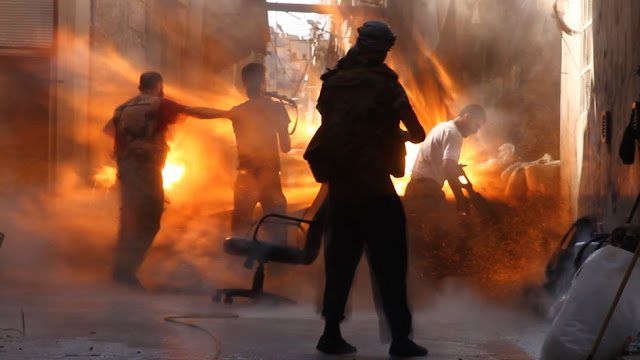
An amazing photo of the exact moment a tank shell hits a rebel post in Aleppo. The guy closest to the camera and the photographer survived, the rest were killed. Pulitzer Prize material right here.
Subscribe to:
Posts (Atom)