Never march by flank in front of an army in position. This principle is absolute.
Napoleon Bonaparte
The only exception to this rule is well known for being an exception to this rule. Lee had Stonewall Jackson do this at Chancellorsville. Knowing his enemy, Joesph Hooker, Lee knew he would get away with it. And he did.

Showing posts with label war. Show all posts
Showing posts with label war. Show all posts
Thursday, September 19, 2013
Thursday, September 5, 2013

Friday, August 30, 2013
Yap
Oh, I am heartily tired of hearing about what Lee is going to do. Some of you always seem to think he is suddenly going to turn a double
somersault, and land in our rear and on both of our flanks at the same time. Go back to your command, and try to think what are we going to do ourselves, instead of what Lee is going to do.
Ulysses S. Grant- the only time he ever lost his temper on the battlefield, after hearing once too often about Lee's ability.
Ulysses S. Grant- the only time he ever lost his temper on the battlefield, after hearing once too often about Lee's ability.


Thursday, August 22, 2013
A Red Line in Syria

It was beginning to look like the Syrian civil war would end in a permanent stalemate. The Economist predicted the country would be functionally be divided in 3. The Alawites taking the belt from Damascus to Aleppo and west to the coast. The rebels controlling the Euphrates valley, and the Kurds their North East portion. Such a result might be viable as the many 3rd parties to the affair could maintain their interests at a relatively low price. Nobody would win, but nobody would lose either.
However, that assumes no game changers. The apparent chemical attacks this week near Damascus could be such a game changer. Somewhere there is a red line, and Assad may have just crossed it.
Chemical weapons have not been used widely since they were banned after WW1. Expensive, finicky, subject to wild swings in efficacy due to weather, and just as dangerous to the attackers as the defenders, chemical weapons have been more trouble than they were worth. It's simply too difficult to get a reliable tactical advantage on the battlefield sufficient to outweigh the political costs. Those political costs are based on the terror chemical weapons inspire in civilians.
Assad seems to have found a way to use them as a poor man's nuke. Lobbing chemical weapons into opposition neighborhoods overcomes the tactical disadvantages. If they are ineffective due to weather, its no loss. The distance between your forces and the targets will be sufficient to avoid exposure if the wind blows the wrong way. There is no effective counter-measure for the rebels. Though their usefulness is limited to terrorizing civilians.
But there is a political cost. At some point, after some red line, the International Community will put aside their differences and squash the Assad regime as a common threat. Last year, the Russians let it be known that they strongly opposed the use of chemical weapons in Syria. Their current rhetoric insists not that its OK to use the weapons, but absent conclusive proof, they have not been used at all. Widespread and blatant use by Assad would render that position untenible. In the big picture, Assad is not an essential asset to the Russians. They will throw him to the wolves if it suits them. Iran will still be there, but Iran cannot stop the Western powers if they decide to intervene.
All this means that Assad can go too far and lose everything. As of today, it looks like the red line has been found.
Wednesday, August 21, 2013
Gettysburg Gate

This is the gate of the Evergreen Cemetery, which gives Cemetery hill its name. It looks much the same as it did in July 1863, apart from the paved road and the nice landscaping. On the second day, the Southerners took the crest of this hill, along with the gate. But they were unsupported, and were driven off by Union re-reinforcements. Lee's best chance to win the battle slipped away due to poor generalship by Ewell, who turned out to be a disappointing replacement for the dead Stonewall Jackson.
Tuesday, July 2, 2013
Gettysburg and Stalingrad


The most iconic images of the two battles. Both staged.
Though vastly different in time, place and circumstance, the battles of Gettysburg and Stalingrad share some interesting similarities.
Both were the culmination of invasions gone wrong. Both marked the strategic high water mark for their respective nations. Both were attacks by smaller, more powerful forces against larger armies, more poorly organized and led.
Although neither battle was decisive, in the sense of deciding the war, both represented a change in momentum that lasted the duration of the contest.
The preceding campaigns had ended in disaster for the battle's defenders, Case Blue in summer 1942 had cleared Southern Russia and cleared the way to the Caucasus, Chancellorsville in May 1863 was the Army of the Potomac's worst defeat.
These previous defeats set the psychological tone for the battles, leading to fatal overconfidence in the invaders. Lee had come to feel (IMHO), that his boys could defeat the North on any field at any time. The German high command, from Hitler on down, were certain the Red Army was on their last legs. Both were looking for a chance to pin the enemy in order to crush them. As a result, neither battle was planned in advance by either side.
The other notable psychological issue was that the attacker's overconfidence led them to discount the ability of the defending soldiers to withstand their assaults. They became contests between the high commands of one side, and the regular soldiers of the other. In both cases, the soldiers stood their ground and won.
On a tactical level, both attacking armies gave up inherent tactical advantages to press the assaults. This changed the nature of the combat, allowing the defenders to at least partially offset the attacker's superior mobility and firepower. The assaults themselves were numerous, and the failure of each to finish off the defenders was taken by commanders to indicate the defenders were weakened enough for the next assault to work. In neither case did the attacking commanders take a step back and contemplate alternative approaches despite the stated objections of their colleagues (most notably Longstreet, and von Richthofen).
But these parallels only go so far. Gettysburg was all Lee, Stalingrad was all Hitler. At Stalingrad, the German side had better equipment and an air force. At Gettysburg, the Army of the Potomac was better equipped, and had a cavalry. Lee's object was to
Meade was unsuited and unable to deliver a strategic counter-stroke. Had I Lee's army on the run, I would have been careful too. The Soviets, on the other hand, delivered a devastating counter-stroke, led by Vasilievsky. The Army of Northern Virginia got away. The German Sixth Army was destroyed.
Wednesday, May 22, 2013
Friday, May 10, 2013
Chancellorsville

Confederate dead at the stonewall outside Fredricksburg, May 1863. This was the same stonewall so bitterly contested in December 1982 during the battle of Fredricksburg.
In the first week of May, 1863, Robert E. Lee disregarded some basic rules of warfare to inflict a stunning defeat on the Army of the Potomac at Chancellorsville. While the win was triumphant, it led to several bad things for Lee. First was the loss of Stonewall Jackson, who died 150 years ago today on May 10, 1863. Second was the confirmation to Lee that the Army of the Potomac was so inept that he could defeat them on any field at any time. This attitude led to Pickett's charge at Gettysburg in July.
Monday, April 29, 2013
Yap
Madness is . . . an affliction which in war carries with it the advantage of SURPRISE.
Winston Churchill on the Ardennes Counter-Offensive, December 1944
Winston Churchill on the Ardennes Counter-Offensive, December 1944
Monday, February 11, 2013
Saturday, February 2, 2013
WW2

The battle of Stalingrad ended 70 years ago today. 70ish years before that was the Paris Commune. 70ish years before that, Nelson was famously disobedient at Copenhagen.
Tuesday, January 22, 2013
Stalingrad Map

Here is a data visualization showing Soviet and Axis deployments on November 18, 1942. It illustrates the German Sixth Army's focus on the the city of Stalingrad, and the Soviet build-up on the more weakly held flanks south and west of the city. The next day, the Soviets attacked with complete surprise. From that day, it was downhill almost all the way to Berlin. Thus November 18, 1942 was the high water mark for the Third Reich.
UGH! The way the image is saved here makes it unreadable. For a better version, I've uploaded it to Flickr. Click on the image to go there.
Monday, September 17, 2012
Sharpsburg

The battle of Sharpsburg took place 150 years ago today. This photo by Alexander Gardner, taken that afternoon, is probably the first photo of a battle while it was in progress.
Friday, September 7, 2012
PIX
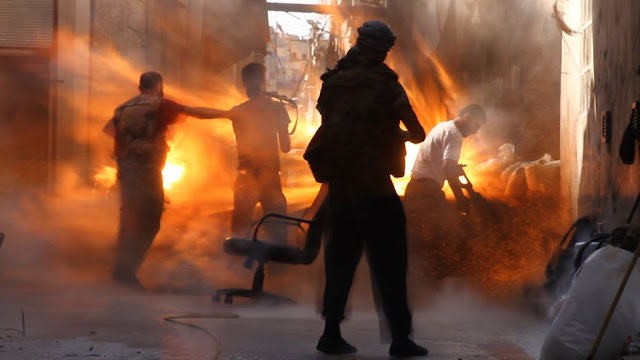
An amazing photo of the exact moment a tank shell hits a rebel post in Aleppo. The guy closest to the camera and the photographer survived, the rest were killed. Pulitzer Prize material right here.
Monday, August 27, 2012
The Syrian Powder Keg

Things are not going well for Bashar Assad. His army had pushed the rebels out of Damascus and seemed to be forcing a decisive battle in Aleppo on their terms. Given the Army's heavy weapons and air assets, it should have been a walkover. But more than a month later, the battle for Aleppo continues. In addition, after having been driven out of Damascus last month, the rebels are not only back, but seem to have shot down a helicopter. The Syrian Armed Forces are clearly unable to win this war. The rebels, on the other hand, have taken everything the government has thrown at them and keep advancing.
The usual scenario in these circumstances is a grinding war until the rebels get the upper hand and the government disintegrates as the players rush for the exits. Without foreign intervention, that's what will happen here. Unfortunately, the regional players have upped the stakes in this conflict. And the chemical weapons are a wild card inviting intervention from the US, France, Britain and possibly Russia.
While we have all been paying attention to Israeli threats against Iran and the Egyptian revolution, a regional war has been brewing to the East. The US invasion of Iraq upset the regional status quo by shoving Iraq (majority Shia) into Iran's outstretched arms. Iran gained a straight line of allies all the way to the Mediterranean (Iraq, Syria, Hezbollah).
The Saudis thus feel out-flanked by Iran and threatened by Iranian nukes. They also felt threatened by Shia demonstrations in the North of the Kingdom, the oil part, and were forced (by their reckoning) to stifle a Shia revolution in Bahrain. So the emerging power blocks are sectarian; Sunni vs. Shia. Russia, Iran, Iraq, Syria and Iran's clients on one side, the USA, Turkey, Jordan and the Gulf Arabs on the other. Egypt is a wild card and Israel irrelevant.
The war in Syria is acting like a magnifying glass to focus all these issues in one place. Iran and the Saudis both lack the military for a direct conflict. One invading and/or conquering the other is not possible. So the temptation to fight by proxy in Syria is attractive. But very, very dangerous. Expect an international crisis at some point this fall.
Subscribe to:
Posts (Atom)