

Showing posts with label Syria. Show all posts
Showing posts with label Syria. Show all posts
Thursday, September 5, 2013
Yap
It's when the 'international community' expresses 'concern' about your 'situation' that your situation is well and truly fucked.
Michael D. Weiss
Michael D. Weiss


Thursday, August 22, 2013
A Red Line in Syria

It was beginning to look like the Syrian civil war would end in a permanent stalemate. The Economist predicted the country would be functionally be divided in 3. The Alawites taking the belt from Damascus to Aleppo and west to the coast. The rebels controlling the Euphrates valley, and the Kurds their North East portion. Such a result might be viable as the many 3rd parties to the affair could maintain their interests at a relatively low price. Nobody would win, but nobody would lose either.
However, that assumes no game changers. The apparent chemical attacks this week near Damascus could be such a game changer. Somewhere there is a red line, and Assad may have just crossed it.
Chemical weapons have not been used widely since they were banned after WW1. Expensive, finicky, subject to wild swings in efficacy due to weather, and just as dangerous to the attackers as the defenders, chemical weapons have been more trouble than they were worth. It's simply too difficult to get a reliable tactical advantage on the battlefield sufficient to outweigh the political costs. Those political costs are based on the terror chemical weapons inspire in civilians.
Assad seems to have found a way to use them as a poor man's nuke. Lobbing chemical weapons into opposition neighborhoods overcomes the tactical disadvantages. If they are ineffective due to weather, its no loss. The distance between your forces and the targets will be sufficient to avoid exposure if the wind blows the wrong way. There is no effective counter-measure for the rebels. Though their usefulness is limited to terrorizing civilians.
But there is a political cost. At some point, after some red line, the International Community will put aside their differences and squash the Assad regime as a common threat. Last year, the Russians let it be known that they strongly opposed the use of chemical weapons in Syria. Their current rhetoric insists not that its OK to use the weapons, but absent conclusive proof, they have not been used at all. Widespread and blatant use by Assad would render that position untenible. In the big picture, Assad is not an essential asset to the Russians. They will throw him to the wolves if it suits them. Iran will still be there, but Iran cannot stop the Western powers if they decide to intervene.
All this means that Assad can go too far and lose everything. As of today, it looks like the red line has been found.
Sunday, May 5, 2013
Israel and Syria

Today the Israeli Air Force carried out a series of air strikes against Syrian military targets around Damascus. The proximate reason was the impending transfer of new, better missiles from Syria to Hezbollah in Lebanon. They have done this twice before, on Friday they hit some targets around Damascus, and in January they hit a convoy near the Lebanese border carrying missiles to Hezbollah. However, the target list (including a chemical weapons research facility) suggest the Israelis are trying to send a more complex message than simply no new weapons for Hezbollah.
Remember that Israel has only ever lost one war, and that was to Hezbollah in 2006. Hezbollah remains the only nearby threat capable of inflicting politically significant damage on Israeli civilians. Right now, the worst case scenario for Israeli security is Hezbollah getting Syrian chemical weapons and the missile systems to deliver them.
The Israelis would probably like to stay out of the Syrian conflict entirely. There is no military action they can take to ensure a palatable outcome. Obviously, there are no political or diplomatic tools they can use either. That leaves Israel in a bind. They can handle Assad, but he is an enabler of the Iran - Hezbollah alliance. What would follow Assad is unknowable at this time. Could be worse, could be better, will certainly be Islamist. But won't be in Iran's pocket and probably won't facilitate Hezbollah.
All in, it looks like a new regime would suit the Israelis. But of course they cannot take sides. Israeli support of the rebels would be the kiss of death and the rebels would reject Israeli help. On the other hand, strategic developments have taken an unusual turn. As far as Syria is concerned, Israeli and Saudi interests are starting to converge. Both are lined up against Iranian influence in Syria and Lebanon. Both would be better off with a Sunni ruled Syria. Both would be happy with a severely crippled Hezbollah. Neither is a military threat to the other. Both are American allies. I'm not expecting a nice meeting between King Abdullah and Netanyahu in East Jerusalem with lots of hugs and kisses. But I wouldn't be surprised to find out they are cooperating under the table.
Finally, the chemical weapons are a wild card. Its hard to divine the truth, but it looks like Assad has been using them in a limited fashion. Trying to gain a tactical advantage without provoking international response. This is one area where Israel gets a free pass. They can bomb the shit out of Assad's chemical weapons capabilities and nobody will blame them.
Its also worth noting that the Israeli raid shows yet again that the Syrian Air Force is utterly incapable of defending Syrian airspace.
Wednesday, October 31, 2012
Syria in October

After a very tense summer, the outside parties to Syria's civil war have stepped back from the brink. The war goes on, but the rebels at least are being starved of weapons by their sponsors. The Americans are worried about weapons falling into the hands of jihadis. The Turks, Qataris and Saudis seem to be heeding American doubts. I have no information on how the Government is doing for supplies, but I wouldn't be surprised to hear the Russians are quietly starving them as well.
In any case, the Syrian military has been notably ineffective in suppressing the rebels despite huge advantages in equipment and manpower. I'd give a win on points to the rebels so-far for simply surviving.
So it seems like there will be a cold, miserable winter in Syria with no resolution. Nevertheless, Syria remains a powder keg. By far the most important issue in the Middle East today. That's because (as I've said before) all the regional fault lines run through it. Syria may end up like Afghanistan where all the regional players would rather have instability than a solid government favouring a different player. In Syria, its the Iranians against the Saudis. Neither will accept a government beholden to the other. So continued war is the safest bet. As long as nobody wins it. The Syrian people don't enter into the calculation, unfortunately.
Friday, September 7, 2012
PIX
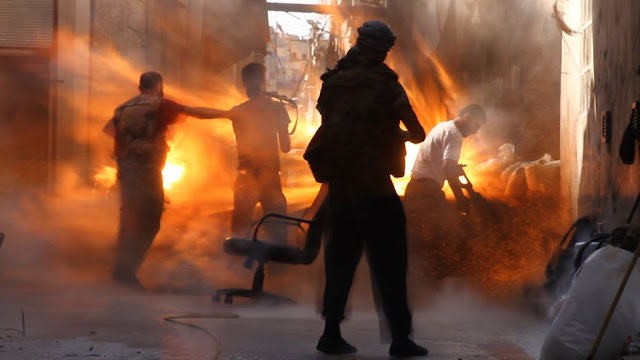
An amazing photo of the exact moment a tank shell hits a rebel post in Aleppo. The guy closest to the camera and the photographer survived, the rest were killed. Pulitzer Prize material right here.
Monday, August 27, 2012
The Syrian Powder Keg

Things are not going well for Bashar Assad. His army had pushed the rebels out of Damascus and seemed to be forcing a decisive battle in Aleppo on their terms. Given the Army's heavy weapons and air assets, it should have been a walkover. But more than a month later, the battle for Aleppo continues. In addition, after having been driven out of Damascus last month, the rebels are not only back, but seem to have shot down a helicopter. The Syrian Armed Forces are clearly unable to win this war. The rebels, on the other hand, have taken everything the government has thrown at them and keep advancing.
The usual scenario in these circumstances is a grinding war until the rebels get the upper hand and the government disintegrates as the players rush for the exits. Without foreign intervention, that's what will happen here. Unfortunately, the regional players have upped the stakes in this conflict. And the chemical weapons are a wild card inviting intervention from the US, France, Britain and possibly Russia.
While we have all been paying attention to Israeli threats against Iran and the Egyptian revolution, a regional war has been brewing to the East. The US invasion of Iraq upset the regional status quo by shoving Iraq (majority Shia) into Iran's outstretched arms. Iran gained a straight line of allies all the way to the Mediterranean (Iraq, Syria, Hezbollah).
The Saudis thus feel out-flanked by Iran and threatened by Iranian nukes. They also felt threatened by Shia demonstrations in the North of the Kingdom, the oil part, and were forced (by their reckoning) to stifle a Shia revolution in Bahrain. So the emerging power blocks are sectarian; Sunni vs. Shia. Russia, Iran, Iraq, Syria and Iran's clients on one side, the USA, Turkey, Jordan and the Gulf Arabs on the other. Egypt is a wild card and Israel irrelevant.
The war in Syria is acting like a magnifying glass to focus all these issues in one place. Iran and the Saudis both lack the military for a direct conflict. One invading and/or conquering the other is not possible. So the temptation to fight by proxy in Syria is attractive. But very, very dangerous. Expect an international crisis at some point this fall.
Tuesday, August 7, 2012
Syria Primer

Currently, Syria is run by an Alawite regime headed by Bashar al-Assad. The Alawite are a group of tribes from western Syria and make up between 10% and 20% of the population depending on who you ask. These tribes practice a form of Shia Islam, in contrast to the majority of the population who are Sunni.
The Alawite have been in control since the sixties when Bashar's father, Hafez al-Assad took over in a coup. Hafez was a master politician, though a brutal and repressive dictator. Bashar is not in the same league and many feel he is first among a group that lead the regime, but not a real force on his own.
Last year, public demonstrations against the regime began, like elsewhere in the Arab world. As the government brutally and ineffectually sought to crush the demonstrations, they gradually became a rebellion. The rebellion itself is divided and includes groups with many different agendas. The only thing they seem to agree on is that the regime has to go (and that they don't like Israel, but that's mom and apple pie in the Arab world).
This year, the rebellion became strong enough to compete with the government in rural areas, and has taken over large swaths of the country. Lately, they have been contesting urban areas, with less success. However, they have survived a month of combat in Damascus, and three weeks of heavy combat in Aleppo.
Several factors, including the attack on Damascus, and the spectacular assasination of Bashar's top security officials have made it clear that the regime is probably doomed. When the trickle of defections becomes a flood, the end will be at hand.
But nothing is simple in the Middle East. Russia, Saudi Arabia, Iran, Iraq Turkey, Qatar and the United States are intervening directly or indirectly. The Russians don't want to lose their last significant Arab client state. The Iranians don't want to see a Shiite regime overthrown, plus Syria is a key strategic ally, helping them get stuff to Hezbollah in Lebanon. The Saudis want very much to have a Shiite regime replaced with a Sunni, and they are funneling guns to the rebels, as is the US (presumably via Qatar). Israel is on red alert, but can't do anything to influence events. So they make concerned noises, but will do nothing unless the chemical weapons come into play.
The chemical weapons are a new factor. The regime moved some out of rebel held areas recently. This was viewed as a good thing by both the US and the Russians. Both remain concerned (as does Israel) that the weapons could fall into the hands of "terrorists". The Russians are said to have warned Assad in very direct language that these weapons must be secured and cannot be used, period.
At the moment, with all the confusion on the ground and the mad spinning by all sides, it is impossible to tell for sure what is going on.
In any case, the most likely outcome is the fall of the regime and the death of many Alawites. Who will replace them and on what terms is unknowable at this point. Just don't believe everything you read.
Subscribe to:
Posts (Atom)